


InnoTrans 2026: CSEE Hosts an Exclusive Panel with SNCF and Deutsche Bahn on French-German Railway Signalling Convergence
Railway Signalling: Towards French-German Convergence
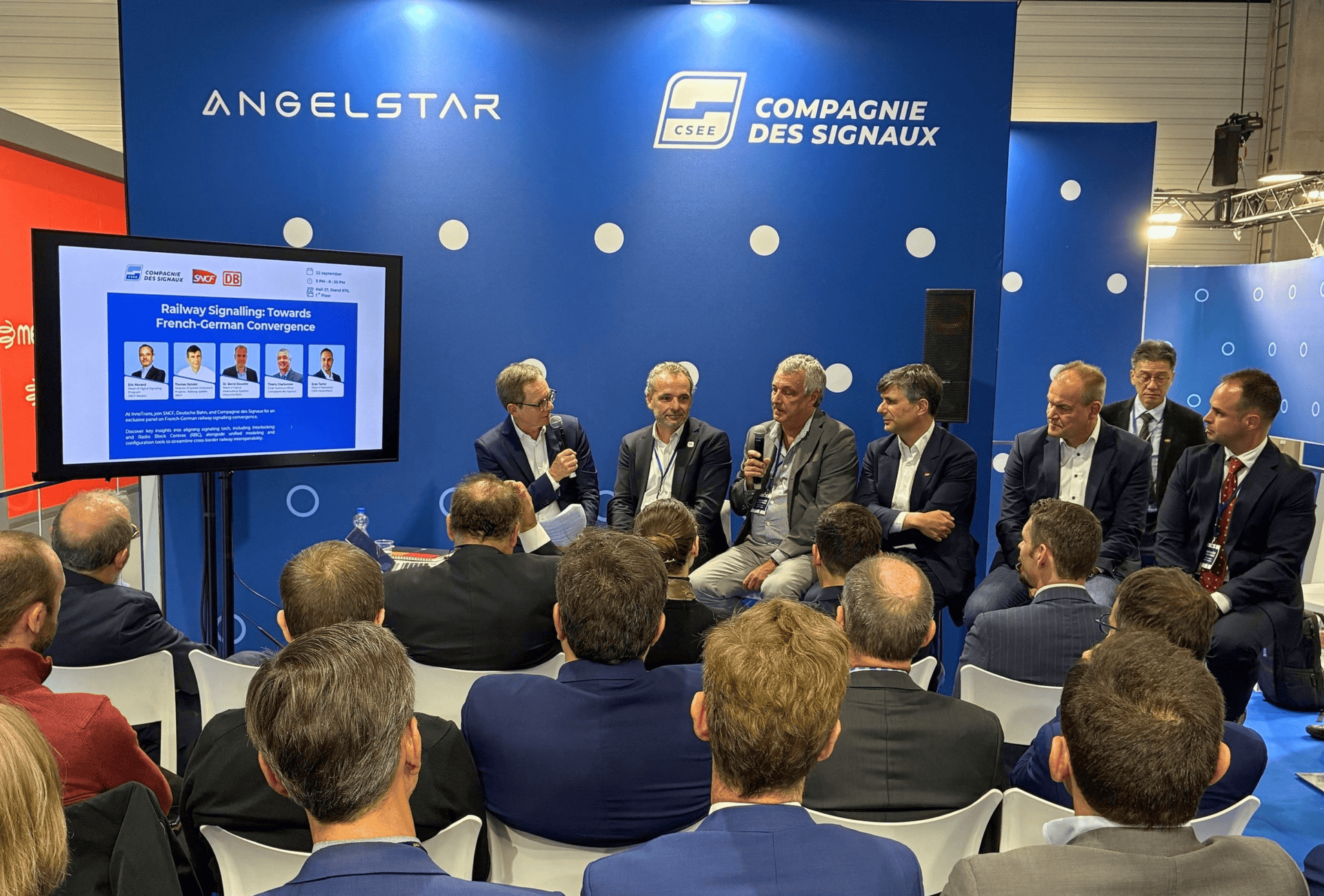
On 22 September 2026, at InnoTrans in Berlin, the world’s leading rail industry trade fair, Compagnie des Signaux (CSEE) hosted an exclusive panel with SNCF and Deutsche Bahn on the theme “Railway Signalling: Towards French-German Convergence“, addressing one of the sector’s most strategic questions for the future of European rail.
Context and stakes
Railway signalling is a strategic lever for the interoperability of the European rail network. As cross-border traffic between France and Germany keeps growing and the EU pushes toward a single rail area, SNCF, Deutsche Bahn and Compagnie des Signaux (CSEE) are joining forces to align their signalling technologies: interlocking systems, Radio Block Centres (RBC), and the modelling and configuration tools used to design them.
Beyond the technical dimension, the stakes are also industrial and operational: reducing lead times and costs, accelerating project delivery and, ultimately, extending convergence to processes and operating rules.
Speakers
The panel brought together five experts. Representing SNCF were Eric Morand, Head of Digital Signaling Program at SNCF Réseau, and Thomas Joindot, Director of System Innovation Projects – Railway System at SNCF. Deutsche Bahn was represented by Dr. Bernd Elsweiler, Head of Digital Interlocking Systems at DB InfraGO AG. Compagnie des Signaux (CSEE) was represented by Thierry Charbonnier, Chief Technical Officer, and Enzo Tavino, Head of Operations at CSEE Deutschland (former MERMEC Deutschland).
Setting the scene: French and German digital signalling programmes
SNCF Réseau’s Argos and Argos RBC programmes are driving the shift to computer-based interlocking, ETCS and new-generation train-detection technology in France.
On the German side, DB InfraGO’s Volumenvertrag (Volume Contract) is a €6.3 billion framework agreement that accelerates the renewal of digital interlockings (DSTW) and the rollout of ETCS, replacing the former ESTW and ERTMS agreements. CSEE Deutschland (former MERMEC Deutschland) is one of the contractors awarded under this framework.
Key drivers of these programmes are :
- drastic reduction of deployment costs
- acceleration of the new digital signaling system deployment
- standardization of the technologies, tools and methods.
Signalling convergence in Europe
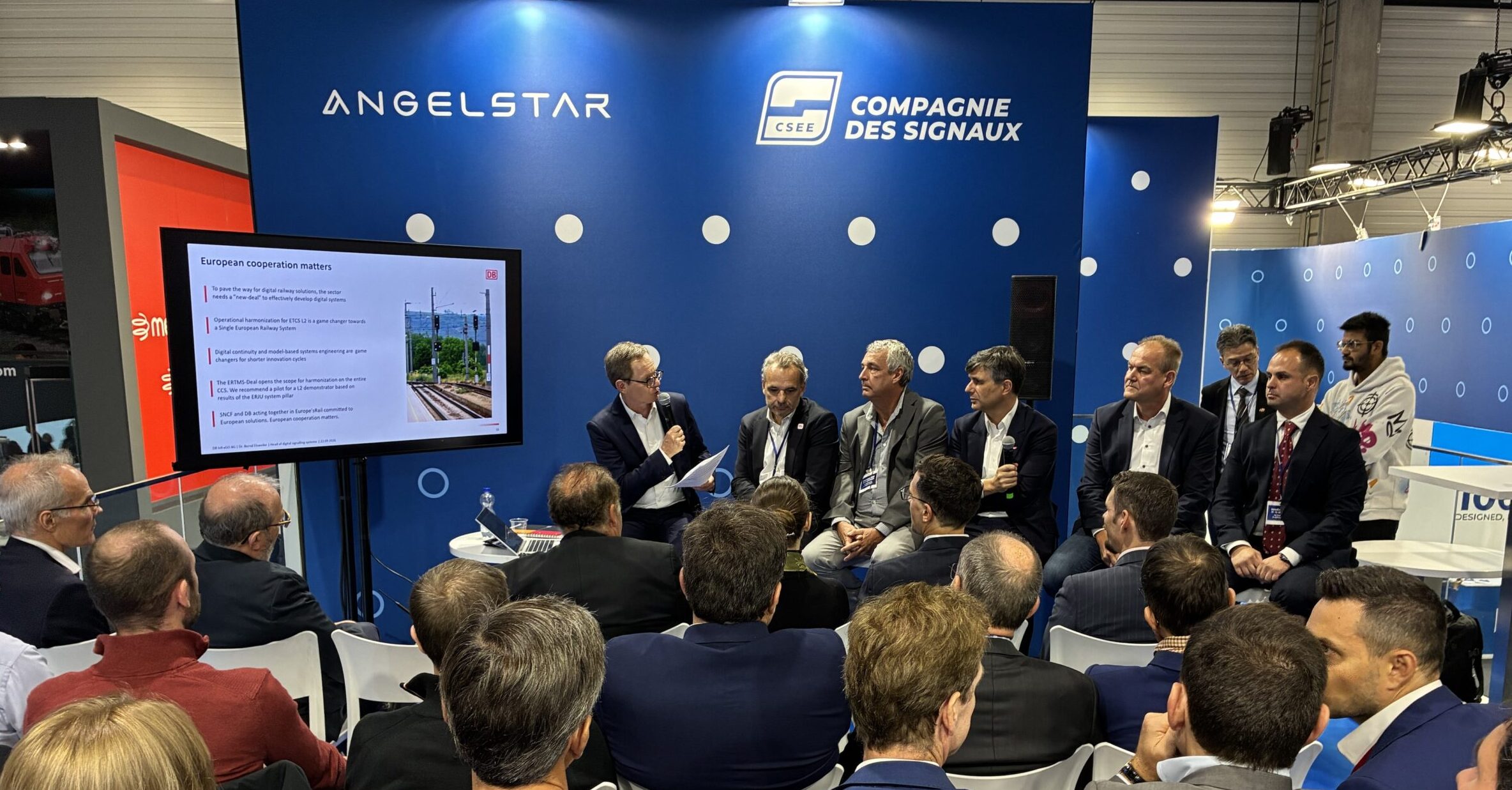
SNCF and Deutsche Bahn are working jointly on control-command systems to advance the harmonization of European signaling technology.
One of the pillar of this convergence is the modeling of signaling principles thru AMS tool as SNCF put in place in the frame of Argos program.
CSEE has developed and integrated an automatic translator in this framework allowing the generation of target SW in a complete end to end engineering process.
As a concrete proof of concept, this process was successfully applied to a subset of Deutsche Bahn Signaling principles modelled in SNCF’s Argos AMS framework then import and run in CSEE automatic engineering process within a week, demonstrating that the same approach can serve both networks.
Execution speed and long-term outlook
Another pillar is digital continuity crucial to decrease execution speed. Two tools proposed by CSEE embody this convergence through practical use cases: the FAST software tool, which enables consistent data sharing across the V cycle starting from importing topological data provided by operator RailML (SNCF) and PlanPro (Deutsche Bahn) formats on both the Argos and Volumenvertrag projects allowing future convergence of signaling data; and a digital twin platform that allows progressive, scalable, remote, multi-technology testing (IXL, CTC, RBC) by combining real and simulated products, significantly reducing on-site testing and project deployment schedule
The Argos technologies and methodology are already helping to speed up project delivery, and both sides are drawing on early feedback (RETEX) to sharpen their next steps and priorities. Looking further ahead, the panellists see scope to broaden European signalling standardisation beyond technology to processes and, ultimately, operational rules, including a proposed pilot for an ETCS Level 2 demonstrator building on the results of the ERJU system pillar.
Across every theme discussed, SNCF, Deutsche Bahn and Compagnie des Signaux (CSEE) reaffirmed a shared determination to deepen their cooperation. Operational harmonisation for ETCS Level 2 is seen as a decisive step toward a single European railway system, and digital continuity and model-based systems engineering as key enablers of shorter innovation cycles.
The three partners reiterated that European cooperation matters, and committed to carrying French-German signalling convergence forward together.